The coffee is just the excuse
By the kilo, Croatia is fifteenth in the world. The habit worth writing about is the sitting: one cup, two hours, and in public since 1748.
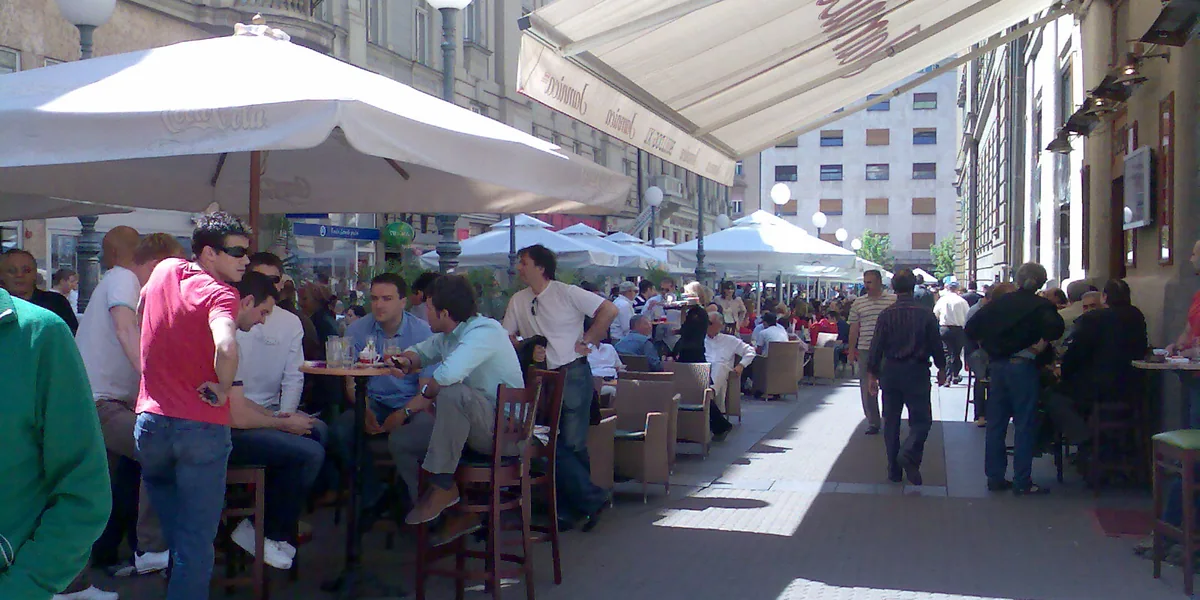
A Tuesday, eleven in the morning, a full terrace. One espresso on the table, cold by now. Nobody is waiting for anything. The bill will come to about two euros and the seat stays taken for two hours.
Eighty-seven per cent of people in Croatia drink coffee regularly, according to an Ipsos survey for HORECA PRO carried out in 2023. Two thirds go to a café at least once a month. Thirty-one per cent drink Turkish coffee every day, mostly at home, and that is the part to remember: the café is for something else. By volume the country is nothing special, 3.8 kilograms a head a year, fifteenth in the world, behind Slovenia at 6.1 and Serbia at 5.4 and a long way behind Finland at 9.6. An older series from the International Coffee Organization, from 2017, gives Croatia 4.9 kilograms, again behind Bosnia and Slovenia.
So the usual line about Croatians and coffee is off. The amount is ordinary. What is out of the ordinary is how long the cup stays on the table, and that it happens in public.
Before Vienna, Istanbul
Three dates carry the beginning of the story, and none of them is Viennese.
On 5 April 1748 a merchant called Leopold Thunn, Dun in some records, opened the first coffeehouse in Zagreb, Kod Duna, in Duga ulica, a few steps from what is now Ban Jelačić Square. He sold coffee, tea and chocolate, colonial goods that came in through the Netherlands, and he died two years later. Venice had its first coffeehouse in 1645, Paris in 1672.
Split got its first known coffeehouse around the 1770s, on the main square, Narodni trg, from a Venetian called Orazio Turcatti, and he ran it the Venetian way. In 1807 a Swiss, Nikola Seleban, opened a Swiss coffeehouse on the same spot, and by about 1860 it was Caffè Troccoli.
And in 1803, the records say, Mehmed Husenšević opened what was called the first Bosnian coffeehouse in Zagreb, in Petrinjska ulica. So two trade routes met in the city, the Venetian one from the south and the Ottoman one from the east, well before the Viennese café turned up and took the credit.
Twenty-five coffeehouses, and a statute that allowed fifteen
In 1900 Zagreb had twenty-five coffeehouses. A city statute from 1887 allowed fifteen, plus 150 taverns, and the street had simply overtaken the paperwork. A. G. Matoš wrote that the service in Ilica was up to Viennese standards.
The coffeehouses sorted people by trade rather than by price. Officers went to Medulić, actors to the Kazališna, writers and bohemians to Corso on the corner of Gundulićeva and Ilica and to Bauer on the corner of Frankopanska, politicians and intellectuals to the Narodna. In Split the Narodna kavana kept a Stol mudraca, a table of sages, an unofficial council which, by the local account, settled more of the city’s questions than the official one. Split at the start of 1941 counted thirteen coffeehouses, eighty inns, sixty-one buffets, thirty-one taverns and seven wine bars.
Palainovka, the oldest one still open, has been pouring since the middle of the nineteenth century.
Chicory first, coffee later
Franck started in Zagreb in 1892, and not as a coffee roaster. It was a chicory plant, a subsidiary of the German firm Heinrich Franck Söhne, making the substitute rather than the real thing. A drying works followed in Bjelovar in 1900, and between the wars the factory made barley coffee. Real coffee came only in 1960, and Jubilarna, the red brick of a pack, first came off the line in 1972. A trade dossier from 2015 put Franck and Julius Meinl together at 65 to 70 per cent of the market; Meinl has been in Croatia without a break since around 2005.
The other change of the twentieth century happened to the building and to the language at the same time. The kavana, with its seating, its newspapers and a waiter in a suit, gave way to the kafić: a counter, an espresso machine, speed. The dictionary kept a record of it. Hrvatski jezični portal has kavana as the formal word and kafić as colloquial, from kafe, which came in from the French café. The older word is for a building, the newer one for a habit.
The words that do not translate
Kava came into Croatian from Turkish kahve, and before that from Arabic qahwa. The orders are local and mostly refuse to translate: kratki is a ristretto; mali makijato is a flat white in an espresso cup; veliki makijato is the same in a cappuccino cup; bijela kava is a latte; produžena is more or less an americano. The names shift from region to region and from café to café, and no dictionary has pinned them down.
Two entries in the national dictionary deserve a moment. Kava razgalica is the morning cup, the one that opens your eyes. Kava sikteruša is the last cup, the one that tells a guest, politely, that it is time to go home. A language with a fixed word for the coffee that ends a visit had rules for the visit too.
Fjaka, and Saturday morning
Encyclopaedia Britannica took in fjaka in 2025 as complete relaxation, the art of doing nothing, and National Geographic Traveller called it a state of mind the same year: not thinking, letting time pass. Neither of them mentions coffee. We do, because it is hard to picture fjaka without a cup going cold on the table.
Špica is the better documented half. In 2014 a thesis at Zagreb’s Faculty of Humanities and Social Sciences, supervised by Ognjen Čaldarović, spent a Saturday morning in Bogovićeva and came back with a conclusion that has little to do with the drink: people come to be seen, on the terraces in the centre, at the hour when everyone else is there too. There is a daytime špica, the older one, and a night one. The coffee is the ticket in.
The third wave, and the third place
Specialty coffee arrived in the middle of the 2000s with Eliscaffe, which Nik Orosi opened in Zagreb. Orosi won the national barista title four times, in 2006, 2007, 2008 and 2013; Matija Hrkać won it three times, 2010 to 2012, and came seventh at the world championship. Orosi’s own verdict on all of it, in 2015: “That title did not bring a single lipa or a single extra guest.” Cogito followed in the early 2010s with its own roastery. By 2017 the country had no SCA chapter and had not held a national championship in four years. The competitions today carry the names of brands, Julius Meinl Barista Cup, Barcaffè Barista Cup. One curated guide lists fifty-eight specialty cafés and five roasteries, and there are certainly more.
The prices moved faster than the coffee. An average cup in Zagreb cost 2.17 euros in October 2025, 34 per cent more than in December 2024, and a 175-gram pack of Franck Jubilarna went from 2.99 to 5.49 euros between April 2024 and October 2025. Croatia has 9,775 registered pubs, bars and coffee shops, a market expected to reach 1.3 billion euros in 2026, which works out at about two and a half places for every thousand residents. Over five years Zagreb lost 13 per cent of its hospitality businesses while Split-Dalmatia and Zadar counties gained; the terraces are moving towards the sea.
Ray Oldenburg, who came up with the term third place in 1989, lists seven things such a place needs: neutral ground that nobody needs an invitation to; no programme, so people come and go as they like; low cost; conversation as the main thing going on; closeness to home or work; regulars, among whom a stranger does not stand out; and chatter, jokes and teasing. Every one of them describes a Croatian kafić as it stands. In June 2025 the WHO’s Commission on Social Connection reported that one in six people worldwide is affected by loneliness, that around 871,000 deaths a year are linked to it, and recommended building places where people can meet without an appointment.
A café is not medicine, and we are not saying it is. We are saying that the thing the WHO is now recommending has been open here since 1748, under a different name.
Science, briefly
In 2015 EFSA concluded that up to 400 mg of caffeine a day from all sources is no safety concern for healthy adults, that single doses up to 200 mg are safe, and that in pregnancy the daily figure is 200 mg.
In June 2016 IARC put coffee drinking in Group 3, not classifiable as to whether it causes cancer in humans, which means the evidence was inadequate rather than that safety was shown. The same evaluation put very hot drinks, above 65 °C, in Group 2A, probably carcinogenic; IARC’s director at the time said the temperature is the problem, not the drink. In a country that serves its coffee very hot, those two findings belong together.
A 2017 umbrella review in the BMJ, covering 201 meta-analyses, found coffee more likely to do good than harm, with the strongest association at three to four cups a day. The same review rated about three quarters of its own findings as very low quality evidence, asked for randomised trials, and recorded higher risks in pregnancy and of fractures in women.
What can be said safely is narrow: moderate drinking in healthy adults shows no net harm, and cause and effect are not established. Coffee treats nothing.
Where sources disagree on a year we give the decade: Palainovka’s opening is given as 1845, 1847 and 1873, Eliscaffe’s as 2005 or 2007, Cogito’s anywhere from 2010 to 2013. The link between fjaka and coffee is ours, not Britannica’s. The two and a half cafés per thousand residents is our arithmetic from the IBISWorld count, not an official figure. We found no systematic regional glossary of coffee orders. The 9.16 kilograms a head sometimes quoted for Croatia is apparent consumption, total supply divided by residents, so it counts what some twenty million tourists drink as if residents drank it. Nothing here describes what coffee does to a body. Thirty sources were read; the nineteen with a stable address are linked.
- Hrvatski jezični portal · kàva — etymology, kava razgalica, kava sikteruša
- Hrvatski jezični portal · kàfīć — colloquial, from kàfē
- Povijest.hr · Kod Duna, the first coffeehouse in Zagreb (1748)
- Povijest.hr · Old Zagreb coffeehouses — the 1887 statute, 25 in 1900
- Narodni.NET · Tradition and history of Split’s coffeehouses — Turcatti, 1941, 4 June 2012
- Ipsos for HORECA PRO · fieldwork 2023, via eZadar, 4 June 2024
- Croatia Week · World of Statistics per-capita ranking, 24 September 2023
- Punkufer / Dnevnik.hr · ICO series 2017, 11 October 2017
- N1 · Zagreb cup €2.17, October 2025, citing Usporedi cijene and Jel poskupilo
- Hrvatska tehnička enciklopedija (LZMK) · Franck d.d.
- Tea Štefek · the Zagreb Saturday špica, FFZG thesis, 2014
- Perfect Daily Grind · Croatian coffee and its journey to specialty, 12 August 2015
- European Coffee Trip · The development of Croatian speciality coffee, 1 July 2017
- IBISWorld · Pubs, Bars & Coffee Shops in Croatia, 2025
- UNESCO Courier · Third places (Oldenburg), 22 March 2023
- WHO · Commission on Social Connection, 30 June 2025
- EFSA · Scientific Opinion on the safety of caffeine, 2015
- IARC / WHO · Press Release 244, 15 June 2016
- Poole et al. · Coffee consumption and health: umbrella review, BMJ 2017